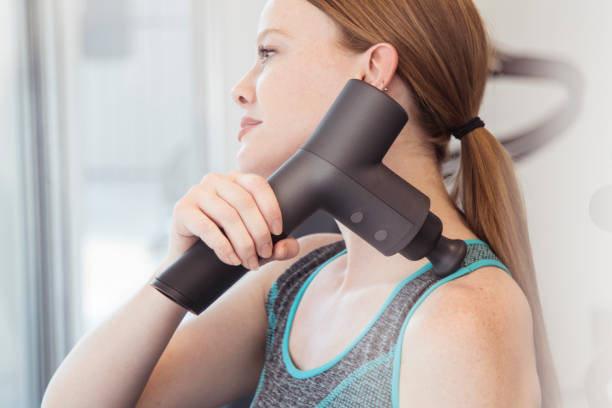
Imagine this: You’ve just finished a late-night run, or you’re looking for a quick relaxation session during your lunch break at the office. Your biggest concern isn’t the sore muscles, but the loud noise your massage gun makes, which disturbs everyone around you.
In the past, high performance often meant high decibels. But thanks to rapid technological advancements, modern fascia guns have reduced their operating noise to a whisper—often quieter than a library. The hero behind this silent technology is the brushless DC motor (BLDC).
This guide will unveil the “black technology” of noise reduction, detailing the revolutionary mechanism of brushless motors and how sophisticated structural engineering allows you to enjoy a deep, effective massage anytime, anywhere without being disturbed by annoying noise.
1. The Root of Noise: Why Friction is the Enemy of Silence
At its core, the power of a fascia gun comes from a motor, which converts rotational energy into high-frequency impact force. The design of the motor directly determines the lifespan and noise level of the device.
The “noisy” mechanism of brushed motors
Early fascia guns or cheap massagers mostly relied on brushed motors, which changed the direction of current through physical contact between carbon brushes and a commutator (i.e., mechanical commutation).
Noise source: The continuous physical friction and vibration between the carbon brushes and the commutator will generate heat, sparks, and most importantly, high-frequency mechanical noise.
The result: Brushed motors are inherently noisy, have short lifespans, and offer unstable power. At high speeds, the noise often exceeds 60dB, loud enough to disrupt nearby conversations.

The BLDC Revolution: The Science of Silence
Today, high-performance massage guns exclusively utilize brushless DC (BLDC) motors. As the name implies, these motors are designed without friction components, resulting in superior efficiency and silent operation.
BLDC motors utilize an electronic controller to manage current commutation, completely replacing physical carbon brushes. The lack of friction means no mechanical wear, minimal heat generation, and virtually no high-frequency friction noise.
Core Advantages: The result is significantly reduced noise, higher energy conversion efficiency, stable performance, and longer life – all key qualities required for fascia guns that require precise control and long-lasting power.
2. Beyond the motor: Three physical buffers for ultimate quietness
While brushless motors eliminate the primary source of noise, it’s not enough to achieve true “library-grade” quietness (typically less than 45dB). Manufacturers must employ complex physical engineering to absorb and isolate the tiny vibrations generated by the motor’s operation.
Application of shock-absorbing and cushioning materials
The rotation of the motor and the rapid reciprocating motion of the piston inevitably generate internal micro-vibrations. If these vibrations are directly transmitted to the outer shell, they will be amplified into audible noise.
Technology Application: Engineers strategically implant high-density silicone pads, foam cushioning cotton or special elastic shock absorbers at key connection points between the motor, drive shaft and housing.
Effect: These cushioning materials effectively absorb shock waves and resonance, isolating mechanical vibrations inside the equipment and preventing them from being converted into airborne noise.
Precision bearings and high-stability transmission system
The “heart” of the fascia gun is the internal transmission structure, which converts the rotational motion of the motor into impact motion. Low-quality bearings and loose parts are the main sources of mechanical noise such as “clicking” sounds.
Technical application: High-precision ball bearings and CNC-machined transmission components are used to ensure extremely small part gaps and smooth displacement during the impact stroke.
Effect: This high-precision design significantly reduces knocks and mechanical friction sounds caused by component collisions and uneven movements.
Acoustic enclosure design and material selection
The shell of the fascia gun is not only a protective layer, but also a key sound insulation cavity.
Technology: Manufacturers use materials such as high-density, high-strength engineering plastics or aircraft-grade aluminum alloys, which inherently offer enhanced sound absorption and insulation properties. Furthermore, the housing’s internal geometry is acoustically designed to dissipate and impede sound waves.

3. Buying Guide: How to Choose a True Silent Massager
When choosing a massage gun, don’t just believe the marketing hype. Understanding how to interpret noise levels is crucial.
Decibel (dB) Specifications
Decibel (dB) is a standard unit of measurement for sound pressure levels.
35−45dB: This is the range that high-end fascia guns can reach when running on low gear, equivalent to a quiet library or a whisper.
50B and above: This level is considered moderate noise and will significantly affect people working or resting nearby.
Buying advice: Look for products that can maintain a stable level of 40dB or less when running at medium and low speeds. This is the truly silent choice.
A delicate balance between power and silence
It should be noted that higher stall force and deeper amplitude (10−14mm) require the motor to output more power, and the noise may increase slightly.
The hallmark of an excellent fascia gun is that it can provide effective amplitude and sufficient impact force while keeping the noise within an acceptable range, achieving a perfect balance between performance and quietness.
Conclusion: Silent technology improves user experience
The silent technology behind the massage gun goes far beyond a simple brushless motor. It’s the result of a synergistic combination of precision mechanics, electronic control, and acoustic engineering. This focus on noise reduction not only improves the device’s durability and efficiency but also fundamentally enhances the user experience, making the massage gun a distraction-free recovery tool suitable for a variety of environments, including home, office, and gym.
When using a fascia gun, do you think there’s a big difference between 40dB and 50dB noise? Are you willing to invest more in truly high-quality silent technology?