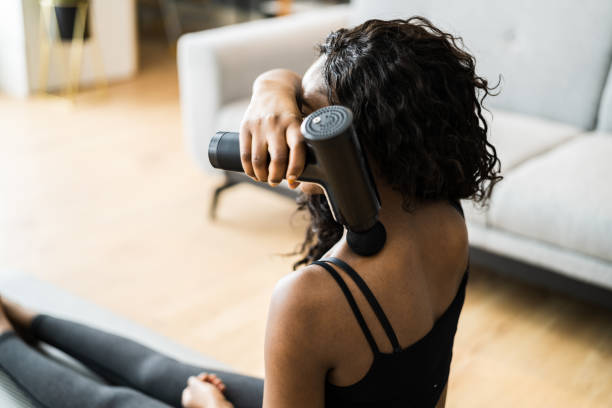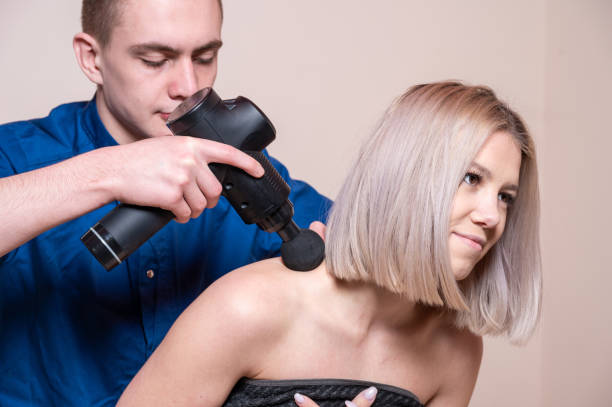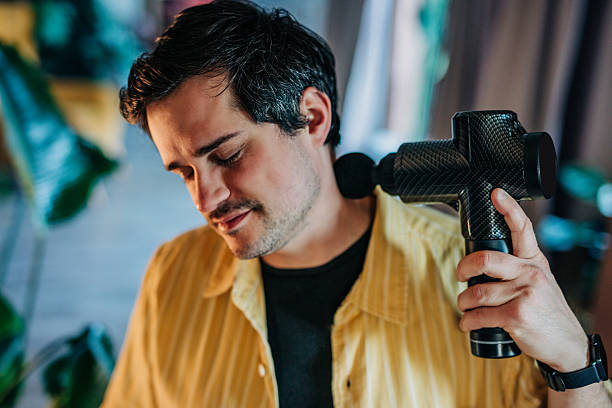
Have you ever struggled to get into a deep hip-opener or backbend in yoga class, only to feel like your body is locked in? You’re not alone. The real bottleneck in yoga advancement often lies not in stretching intensity, but in stability and the mind-muscle connection between key muscles . Long hours spent at a desk can cause our gluteus maximus to lose their memory and our hip flexors to shorten.
Rather than battling stiffness on the mat, give your muscles a “pre-activation” signal before you begin. The optimal role of a percussion massager in yoga isn’t to induce deep relaxation, but rather to act like a high-tech caffeine boost, quickly awakening target muscle groups and allowing you to enter poses in a safer and more efficient state.
This article will reveal to you the secrets of fascia guns in yoga – how to activate the five core muscle groups in a targeted manner and unlock the yoga poses you most desire to achieve.
The Science of Activation: Why the Fascia Gun is Better Than Static Stretching
Before practicing yoga, your goal is to increase blood circulation, raise muscle temperature, and wake up those “sleeping” muscle groups. The fascia gun can quickly achieve these goals through its high-frequency vibration:
Quickly activate the muscle “switch”
Awakening deep inhibition: Major muscle groups such as the gluteus maximus (Glutes) are often in a “suppressed” state after sitting for a long time. The impact of the fascia gun can send proprioceptive signals to instantly improve muscle recruitment ability.
Increased blood flow: Compared to static stretching, quick, gentle impacts can more effectively pump blood to the target area and improve muscle elasticity, which is the core of a dynamic warm-up.
Reset the nervous system: The fascia gun helps temporarily reduce the viscosity of the fascia, allowing your muscle nerves to better receive instructions from the brain, thereby reducing compensation in the pose.
Operating Guidelines: During the pre-activation phase, use low to medium intensity and high frequency settings, sweeping quickly for 30-60 seconds on each part , aiming for “awakening” rather than “fatigue.”
5 Core Poses and a Pre-Activation Strategy for the Fascia Gun
For different yoga challenges, you need different activation focuses.
1. Hip Strength: The Foundation of Balance and Backbends
Target poses: Warrior III, Tree Pose, Bridge Pose, and other poses that require single-leg standing or pelvic stability.
Postural impairments: Weakness in the gluteus maximus and medius muscles leads to pelvic instability and increased stress on the lower back.
Activation site: gluteus maximus and gluteus medius.
Technique: We recommend using a rounded or flat head . Quickly sweep across your glutes, adding slight pressure to locate any areas of tightness. Repeat for 30 seconds . Immediately after activation, perform a few short glute bridges on your mat to feel the effects.
2. Hamstrings: Unlocking Deeper Forward Bends
Target poses: Forward Fold (Uttanasana), Triangle Pose.
Postural obstacle: Excessive tightness in the hamstrings, which limits anterior pelvic rotation.
Activation site: The back of the thigh (hamstrings).
Technique: Using a flat head is recommended . Sit in a chair with your legs relaxed. Move along the back of your thigh, starting just below your sitting bones, and quickly sweep downward to just above your knee. Activate for 30-45 seconds to temporarily increase elasticity.

3. Hip Flexors: Release Points for Backbends and Hip Openers
Target poses: Low Lunge (Anjaneyasana), Dancer’s Pose, Pigeon Pose.
Postural obstacles: Prolonged sitting shortens the hip flexors (such as the iliopsoas), limiting hip extension and hindering the depth of backbends.
Activation site: Above the groin area, in front of the pelvis.
Skill: Use extreme caution! We recommend using an air-actuated or flat tip . Gently sweep the soft tissue area below the front of the pelvis for 30 seconds using the lowest setting and very light pressure . This area contains important nerves and blood vessels, so avoid heavy pressure.
4. Upper limb support: Laying the foundation for arm balance and stability
Target poses: Downward-Facing Dog, Plank, Chaturanga, Handstand preparation.
Postural obstacles: Tight chest muscles (causing rounded shoulders) and insufficient activation of the rotator cuff muscles.
Activation site: Pectoralis major, deltoids, outer arms.
Technique: Using a flat head is recommended . Quickly sweep across the front of the shoulder (deltoids) to activate the supporting muscles. Then, gently sweep along the underside of the clavicle and along the pectoralis major to release chest tension and help you open your chest better.
5. Calf and tibialis anterior muscles: Stabilizers for stance and ankles
Target poses: All standing and balancing poses, Mountain Pose, and tiptoe exercises.
Postural impairments: Stiffness in the calf (Calves), which affects ankle mobility; weakness in the tibialis anterior muscle.
Activation site: The tibialis anterior muscles on the back and front of the calf.
Technique: Using a flat head is recommended . Start with quick sweeps along the back of the calf to increase flexibility, then gently sweep along the front of the calf (outside the shin) for 30 seconds to awaken the ankle stabilizers.
Safety First: Observe the “Fascia Gun Red Line” on Your Mat
Introducing a fascia gun into yoga is highly effective, but it should never come at the expense of safety:
Avoid bones and joints: The fascia gun is designed for soft tissue. Always avoid bones, joints, spine and sensitive areas (such as the front of the neck).
Intensity and time rule: Remember, your goal is activation , not massage . Keep the intensity low to medium and the pressure gentle, and never stay on any one point for more than 10 seconds.
Does not replace a dynamic warm-up: The fascia gun is just an accelerator. You still need to do range of motion exercises and dynamic stretching to fully prepare for your yoga practice.
Conclusion: Unleash your athletic potential
In the world of yoga, the fascia gun is a modern tool that helps you transcend stiffness and compensation. It allows us to move beyond painful “hard stretching” and toward scientific “smart activation.” Through targeted preconditioning, you’ll experience deeper poses, greater stability, and more fluid connections.
Use a fascia gun to find the “hidden switch” of your body!
After trying these five activation methods, which pose felt most unlocked? Share your breakthroughs in the comments!