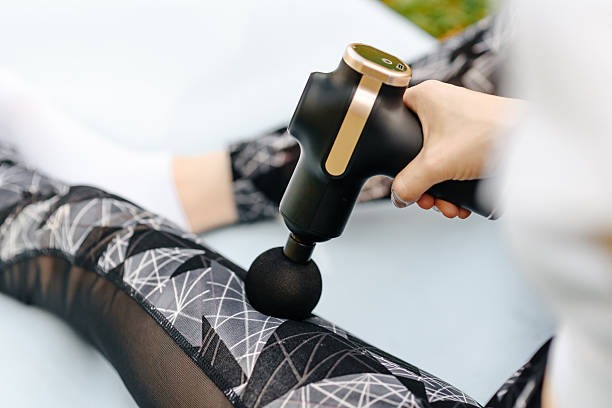
Have you ever felt like your muscles were run over by a truck the day after an intense workout or a long run? This feeling, known as delayed onset muscle soreness (DOMS), is a near-universal pain point for fitness enthusiasts and athletes. It not only makes walking and climbing stairs a challenge, but it can also severely impact subsequent training plans.
In recent years, a highly effective recovery tool— the Massage Gun (or Percussion Massager) —has become a new favorite in the athletic community. It promises to accelerate muscle recovery and quickly relieve soreness. But do Massage Guns actually work? How do their high-frequency vibrations penetrate deep into the muscles to combat DOMS? This article delves into the science, explaining how Massage Guns work and providing a guide to efficient and safe American-style recovery . Are you ready to take your workout recovery to a whole new level?

Beating DOMS: The Science of the Fascia Gun
To understand how the fascia gun works, we must first address a common misconception: DOMS isn’t caused by lactic acid accumulation. Modern sports science confirms that DOMS primarily occurs after eccentric exercise and is caused by microscopic damage to muscle fibers , triggering a localized inflammatory response . The fascia gun intervenes in this process through three scientific approaches:
1. Myofascial Release
The fascia gun uses its unique percussive therapy to impact deep muscle tissue at a high frequency of several times per second. This is not just a surface vibration, but a deep, targeted stimulation.
Relaxation reflex: High-speed vibrations stimulate the Golgi tendon organs (GTOs) in tendons and muscles . These GTOs act as “tension sensors” in muscles. When stimulated, they send signals to the spinal cord and brain, triggering a reflex relaxation of the muscles . Imagine the fascia gun telling your tense muscles, “Hey, it’s time to calm down.”
Release “adhesions”: After strenuous exercise, adhesions may form between muscle fibers and the fascia covering them , causing stiffness and limited mobility. The impact of the fascia gun helps break up these adhesions , restore the normal sliding of fascia and muscle, and restore tissue elasticity and mobility.
2. Accelerate local metabolism and circulation (Circulation Boost)
Part of the DOMS pain comes from the accumulation of inflammatory substances and metabolic waste. The impact of the fascia gun can effectively solve this problem:
Improve blood flow: Strong vibrations can quickly increase blood flow and tissue temperature in the massage area , just like injecting a warm current into your muscles.
Accelerated clearance: Improved blood circulation means more oxygen and nutrients are delivered to damaged muscles, while inflammatory factors and metabolic waste are more effectively cleared . While lactic acid isn’t the primary cause of DOMS, accelerating its clearance is always beneficial for overall recovery.
3. Use Pain Gate Theory to Distract Your Attention
This is a neurological intervention.
Sensory “overtaking”: According to the pain gate control theory , high-frequency non-painful sensory input (i.e., the vibration of the fascia gun) stimulates the thick sensory fibers on the body surface . These signals reach the spinal cord and brain before pain signals, “closing” or “closing” part of the pain “gate,” thereby immediately alleviating the soreness and discomfort you feel subjectively.
Your Recovery Accelerator: A Guide to Effective and Safe Use
The fascia gun is not a universal hammer that can hit wherever it hurts. Only by mastering the correct usage strategy can its effectiveness be maximized.
The best time window: When to start “recovery mode”?
| When to use | Goal and intensity recommendations |
| Within 15-30 minutes after exercise | Goal: Initial relaxation, avoiding excessive stiffness. Intensity: Low to moderate. This helps with good blood circulation to the muscles, aiding initial metabolism and relaxation. |
| Peak DOMS (24-72 hours) | Goal: Relieve deep-seated pain and stiffness. Intensity: Low. Keep it gentle, aiming for soreness rather than sharp pain, with an emphasis on relief. |
| Warm up before exercise | Goal: Wake up muscles, increase blood flow, and prepare for training. Intensity: Low. Quickly sweep each area for 30 seconds. |
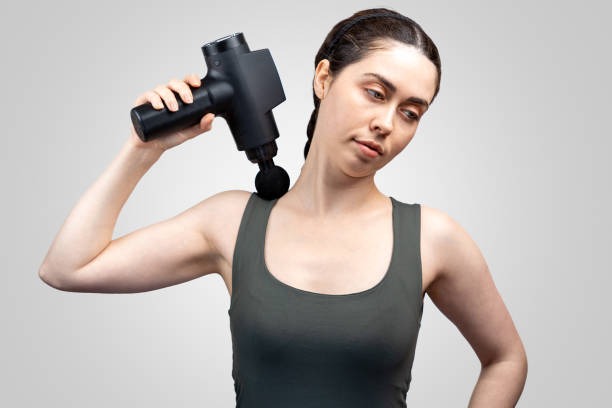
“Safety First” operating principle
Remember, a fascia gun is very powerful, and like using a power tool, you need to follow strict safety procedures:
1. Intensity and Duration: Less is More
Strength principle: Start with the lowest frequency and gradually adjust. The optimal state is to feel a “deep stimulation but tolerable soreness” . If you need to reach an 8/10 or even higher pain level to feel effective, it is likely that you have overstimulated your body.
Duration: Treat it like espresso. Stay in each major muscle area (e.g., quadriceps, gluteus maximus) for 30 seconds to 1 minute . Don’t dwell on a single trigger point for more than 3 minutes, as this can lead to muscle fatigue or even injury.
2. Body Part Selection: Large Muscle Groups Are King
The fascia gun is best used on large muscle groups and fleshy areas .
Preferred areas: Thighs (front and back), buttocks, calves, and broad back muscles (trapezius and latissimus dorsi).
How to move: Slowly move the gun tip along the direction of the muscle fibers, allowing the impact force to “scan” the entire area.
3. Restricted Area List: Areas You Must Not Touch
Remember to avoid the following “red alert zones”:
Bones, joints, and bony protrusions (such as knees, elbows, ankles, and collarbone).
Spine and cervical spine : These areas are densely packed with nerves and blood vessels, and a direct impact can cause serious injury.
Chest and abdomen : There are important organs inside, and strong vibrations are very dangerous.
Inflammation and wounds : Stop use immediately if there is redness, swelling, heat, bruising or open wounds.
Conclusion
The fascia gun is undoubtedly a star in the modern sports recovery toolbox. It uses scientific principles to effectively transform post-exercise “passive waiting” recovery into “active intervention” recovery. It is not a magical healing tool, but a “pass” to accelerate your body’s recovery after hard training.
But remember, no tool can replace adequate sleep, proper nutrition, and proper stretching. Think of the fascia gun as a powerful adjunct to your recovery process , not the be-all and end-all.
Now’s the time to grab your “recovery accelerator” and say goodbye to those excruciating DOMS. What’s your favorite area to “tap” with a fascia gun? What’s the biggest difference it’s made for you? Share your experiences in the comments section, and let’s explore smarter ways to train and recover!