As a beginner of fascia gun, your biggest confusion may be: How much force is effective without making me jump in pain?
The core of a fascia gun’s power lies in its stall force . Stall force refers to the maximum downward pressure the fascia gun can withstand while maintaining stable operation. Simply put, it determines whether the motor stops or slows down when you press the gun tip.
For beginners, choosing stall power isn’t about “bigger is better.” It should be perfectly matched to your pain threshold and muscle type . Here’s a beginner-friendly guide to help you find your “power sweet spot.”

Stall Force and Pain Threshold: Finding Your Sweet Spot
An “effective” massage does not necessarily mean the “most painful” massage. Excessive pain may trigger protective muscle contraction , making the muscles even stiffer.
Pain assessment: 0-10 scale
When choosing the strength of the fascia gun, it is recommended to use the Pain Scale to guide your operation:
0-2 points (no pain or slight irritation): Suitable for warm-up activation, daily relaxation , or targeting very sensitive areas (such as the upper trapezius).
3-4 (Comfortable Soreness): This is the optimal “sweet spot” for relaxation . You feel pressure and soreness, yet you remain relaxed and breathing evenly. This is the ideal intensity for relieving post-workout soreness and releasing trigger points.
5 points or more (pain or discomfort): Immediately reduce the pressure or change to a lower setting. A pain level above 5 indicates you are overstimulating the muscles, which can cause counterproductive effects or tissue damage.
Beginner’s guide: Always start with the lowest setting and lightest pressure, keeping the force within a comfortable soreness range of 3-4 points .
Ideal for beginners:
If this is your first time using a fascia gun, or your main purpose is to relieve the superficial stiffness and shoulder and neck discomfort caused by long-term sitting in the office , then the Mini or entry-level fascia gun from StallForce is an ideal choice.
The advantages of this type of fascia gun are:
Gentle start: Low stall force allows you to feel a soft impact in the lowest gear, effectively activating muscles.
Lower noise: Usually paired with a quieter motor, suitable for use in quiet environments.
Avoid overexcitement: The lower stall force forces you to operate gently, naturally avoiding the “overexertion” mistake often made by beginners.
Tips: Use your body, not the machine, to control the force
Even if you have a professional-grade fascia gun with a high stall force , beginners should adjust the force through their own control rather than relying on the high gear of the machine.
Force control from outside to inside
External control: gun tip selection
Choose a soft/wide gun tip: When using for the first time, choose an air cushion tip or a large round tip . They have a large contact area, disperse the impact force, and feel softer.
Avoid hard/narrow gun tips: Bullet-shaped and U-shaped tips concentrate pressure on a small point, causing more pain. They should be reserved for more experienced individuals to precisely address trigger points.
Middle level control: gear selection
Always start at the lowest setting (1). Only when you are applying pressure at the lowest setting and the pain level is below 3, consider moving up a setting.
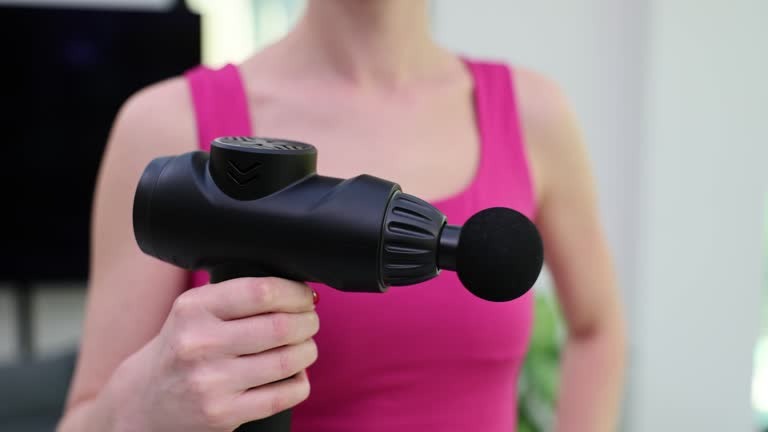
Internal control: applying pressure
Let the gun do the work: At first, just let the gun tip rest lightly against your skin without actively pressing down.
Gradual pressure: Only when you get used to the vibration, slowly and deliberately increase the pressure slightly until you reach a comfortable soreness point of 3-4 points .
Summary: Slow down and feel it
The best strategy for beginners is to use a low-stall or medium-stall fascia gun, keep the gear low, and use a gentle touch to find your sweet spot.
Fascial release is a gradual process. Don’t rush to achieve deep pain, but rather seek steady, continuous stimulation that maintains your breathing. As your muscles adapt, your pain threshold will naturally increase, allowing you to gradually experiment with greater stall forces.
Do you consider yourself a “newbie” who is more sensitive to pain, or an “old hand” who can withstand greater pressure?